NEWSLETTER
The Dose
The New Map: Who's Really Winning the Global Biopharma Race
Issue 002 · July 2026
Issue Thesis
The global biopharma race is not being won by geography alone. It is being won by teams that can control the right capabilities across geography: discovery, AI models, clinical execution, manufacturing resilience, regulatory confidence, and commercial reach.
Executive Summary
This issue is about a simple shift: the old global biopharma map no longer explains where power sits.
BIO 2026 made the China question harder to avoid: dependency is now a strategic variable, not a supply-chain footnote.
Recent dealmaking shows capability moving across borders. In the last month alone, AI discovery ($2.5B), oncology ($10.6B), commercial scale ($11.75B), and immunology ($10.9B) assets were acquired or partnered wherever they created leverage.
Regulators are drawing their own maps. Trodelvy's FDA expansion clarifies an oncology treatment pathway, while Europe's Critical Medicines Act turns supply resilience into policy.
The pattern is not a simple West-versus-Rest scoreboard. Western pharma still controls much of the capital, regulatory trust, and commercial infrastructure. China and APAC are increasingly shaping discovery velocity, development capacity, and strategic optionality - a dynamic BIO 2026 put front and center, with CEO John Crowley warning the U.S. against deeper, harder-to-unwind dependencies across the ecosystem.
For life sciences teams, the message is clear: the story has to move beyond logos and markets. The stronger deck shows where the asset sits, which geography creates leverage, which dependency creates risk, and which capability actually wins the next decision.
The Dose · Issue 002
Get the next issue before your next pitch.
Funding signals, regulatory moves, and the slide that wins the room — straight to your inbox, once a month.
01 · The Signal
One structural shift. Explained clearly.
BIO 2026 made the industry's China dependency harder to treat as background noise.
BIO CEO John Crowley framed China as a serious biotech power while warning that the United States needs to avoid deeper, harder-to-unwind dependencies across the life sciences ecosystem. The warning matters because the dependency is no longer only about low cost manufacturing. It now touches discovery services, clinical trial execution, biologics capacity, licensing flows, and the speed with which programs can move from idea to evidence.
That is the new map. Biopharma advantage is being distributed by capability layer:
Discovery map
where validated targets, AI models, medicinal chemistry, and modality expertise are actually emerging.
Development map
where trials can recruit, execute, and generate credible data fast.
Manufacturing map
where biologics, APIs, and critical inputs can be produced without creating unacceptable dependency.
Regulatory map
where policy is trying to protect resilience without blocking patient access to innovation.
Commercial map
where launch infrastructure, payer access, and physician trust convert science into revenue.
The strongest companies will be the ones that can explain their position across this map. The weaker stories will be the ones that still treat geography as a sidebar.
What this means for you: If you are raising, licensing, partnering, or preparing a board update, show the capability map before the market map.
Investors and strategics want to know not only what you own, but where the work happens, what the dependency profile looks like, and which node in the global system makes your story stronger.
02 · Global Pulse
Deals and partnerships reshaping the map this month.
This month's deal flow points to the same conclusion from different angles: biopharma is buying, partnering, and repositioning around capability, not just geography.
Insilico + SK Biopharmaceuticals
Discovery map
Up to $2.5B potential value; $18M upfront and near-term milestones.
APAC capabilities are not just low-cost execution. They are becoming discovery, development, and commercialization nodes.
GSK + Nuvalent
Development map
$10.6B acquisition for three lung cancer assets, including two late-stage NSCLC inhibitors under FDA review.
Large pharma is paying for mapped precision: validated target, clear patient segment, defined regulatory timing, and near-term launch optionality.
Sun Pharma + Organon
Commercial map
$11.75B enterprise value all-cash transaction.
The map is not only US/EU big pharma buying biotech. India-based pharma is also buying global branded infrastructure.
AbbVie + Apogee
Development map
$10.9B equity value; lead IL-13 asset in late-stage atopic dermatitis.
Strategics are moving where the capability map is legible: disease leadership, clinical-stage differentiation, and commercial fit.
The common thread is precision. These are mapped bets: a neuroimmune AI engine paired with CNS development capability, a lung cancer portfolio with visible FDA timing, a women's health platform with global commercial reach, and an immunology pipeline that fits AbbVie's disease-area authority.
That is why the geography conversation is becoming more strategic. The sharper question is not which country is winning. It is which country, company, or partner controls the capability that makes the next milestone easier.
03 · Pipeline Watch
A Western regulatory win that anchors the treatment map side of the issue.
Trodelvy's June 24 FDA approval for first-line unresectable locally advanced or metastatic triple-negative breast cancer gives this issue a concrete clinical anchor.
The approval expands Trodelvy from a later-line treatment into a first-line backbone option across PD-L1 status. For PD-L1-negative or PD-L1-inhibitor-ineligible patients, it can be used as a single agent. For patients whose tumors express PD-L1, it can be used with Keytruda or Keytruda Qlex.
The strategic point is not only that an ADC won another label. It is that the label redraws a treatment map in a hard-to-treat cancer. The approval tells clinicians where Trodelvy can sit earlier, tells investors where Gilead can defend oncology relevance, and tells competitors that ADC value is increasingly decided by exact line of therapy, biomarker position, combination logic, and durability of evidence.
For patients
an earlier targeted option in an aggressive cancer with historically limited choices.
For clinicians
a clearer first-line pathway across PD-L1-defined segments.
For companies
another reminder that oncology stories need label geography, not just mechanism excitement.
04 · Regulatory Watch
Policy is drawing its own map of strategic resilience.
Europe's Critical Medicines Act is the regulatory mirror image of the BIO 2026 anxiety.
The European Commission's framework is designed to strengthen availability, supply, and production of critical medicines in the EU. Its key features include strategic projects for critical medicines or ingredients, procurement tools that reward resilient supply chains, collaborative procurement among member states, international partnerships with like-minded regions, and state aid guidance for member-state support.
In newsletter terms, this matters because regulation is no longer only the final gate for an asset. It is increasingly a map of acceptable dependency. Policymakers are asking where essential medicines are made, how procurement can reward resilience, and how much reliance on a single supplier or geography is tolerable.
Strategic read: Regulatory strategy and supply-chain strategy are converging; decks must now show exactly where operational risk sits.
05 · Editor's View
What the AI collaborations and manufacturing dependency signal for the next 12-18 months.
Two stories in this issue seem unrelated — Insilico's AI deal with SK Biopharmaceuticals, and Europe's Critical Medicines Act — but they're really the same story told twice.
For years, biopharma treated "find the molecule fast" and "make it cheap" as separate problems. BIO 2026 made it clear they're not. When John Crowley warned about deeper, harder-to-unwind dependencies, he was pointing at something specific: the fastest discovery engines and the most efficient manufacturing often sit in the same place now. And that place isn't always where a Western biotech's regulatory relationships live.
That's why the Critical Medicines Act matters more than it looks. It's Europe putting a price on resilience instead of just hoping companies manage the risk themselves. Expect more of this over the next year — regions tying supply-chain transparency to approvals and reimbursement, not just trade policy.
For AI-first discovery companies, the bar just moved. Speed used to be the whole pitch. Now investors want to see the path from validated target to actual, reliable supply — before they sign, not after.
Speed still matters. But the teams who can also answer "where does this actually get made" are going to have an easier time raising in 2027.

06 · The Deck
Why the standard competitive landscape slide fails before anyone reads a word.
Most life sciences competitive landscape slides fail for the same reason a badly built clinical deck fails: everything is painted in one colour, so the eye has no way to tell what kind of information it's looking at. A logo grid where every company sits in the same box, same shade, same weight isn't a design choice - it's a missing hierarchy.
A1 Slides has reviewed this pattern across thousands of life sciences slides through our clinical data visualisation work. The fix isn't a new framework - it's the same colour zoning discipline that governs any clinical deck: a hero statement that immediately signals the one insight that matters, a comparison zone with clear structural differentiation, a supporting evidence layer that holds detail without competing for attention, and a summary zone that signals what to do next.
Applied to this month's landscape problem, that means: the deal or company that matters most this cycle gets the hero treatment. The capability comparison (who's playing where) gets a neutral, grid-friendly zone. Dependency and risk detail sits in a recessive tone that's present but doesn't dominate. And the takeaway - what a reader should believe after seeing the slide - gets its own accent zone, the way a summary slide would.
Deck test: If your competitive slide uses one colour for every company and every data type, it isn't showing a landscape - it's showing a list.
Read the full breakdown of colour zoning and visual hierarchy in life sciences decks.
07 · Off The Deck News
Introducing the A1 Slides Project Portal.
The pace of life science consulting rarely aligns with a single time zone. Teams work across continents, deadlines shift overnight, and presentation support often becomes the bottleneck between a completed analysis and a client-ready story.
To simplify that process, A1 Slides has introduced a new Project Portal: a dedicated support workspace designed specifically for life science consulting teams.
Submitting a project now requires only two essentials:
- Your draft presentation or report.
- The treatment type or required service.
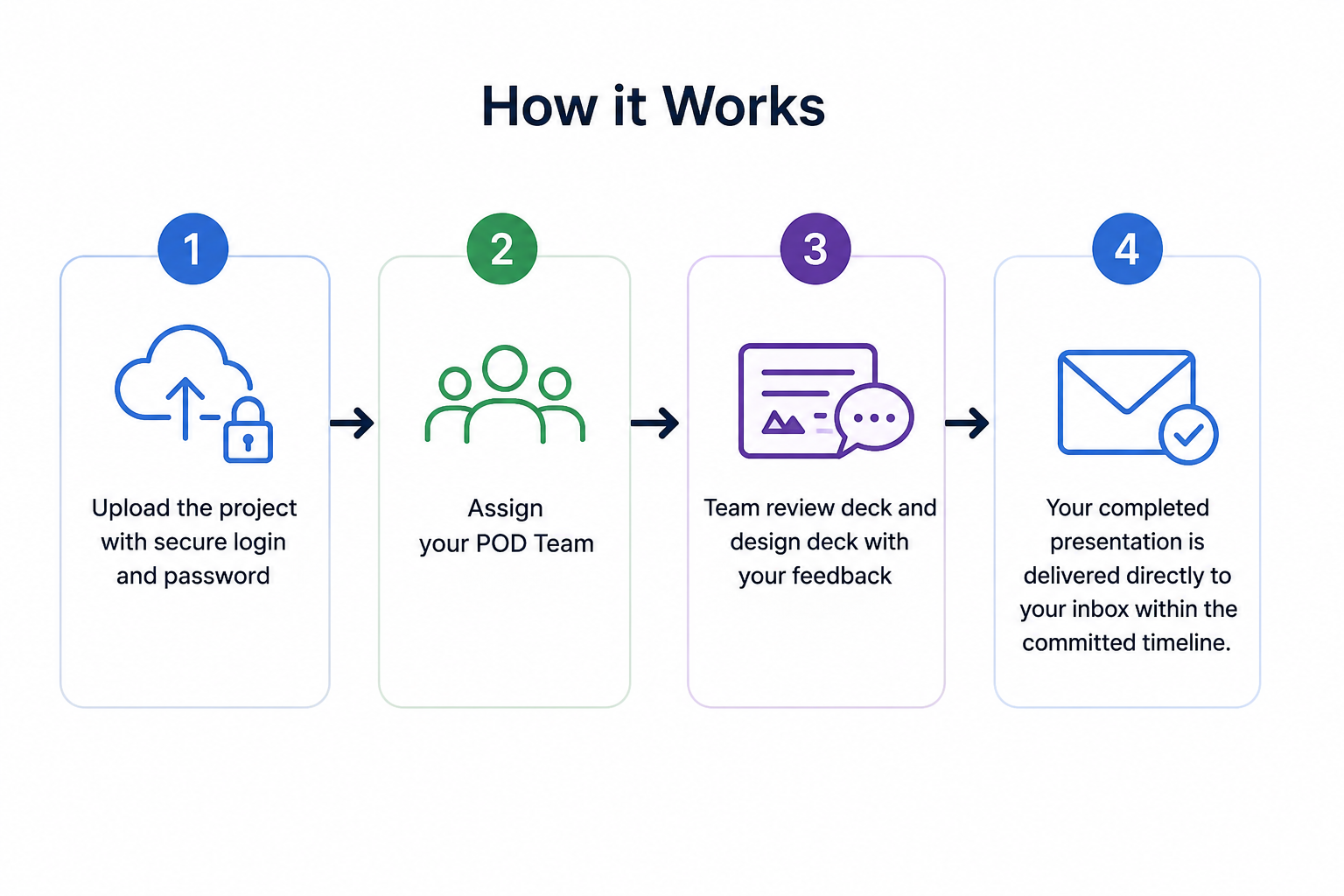
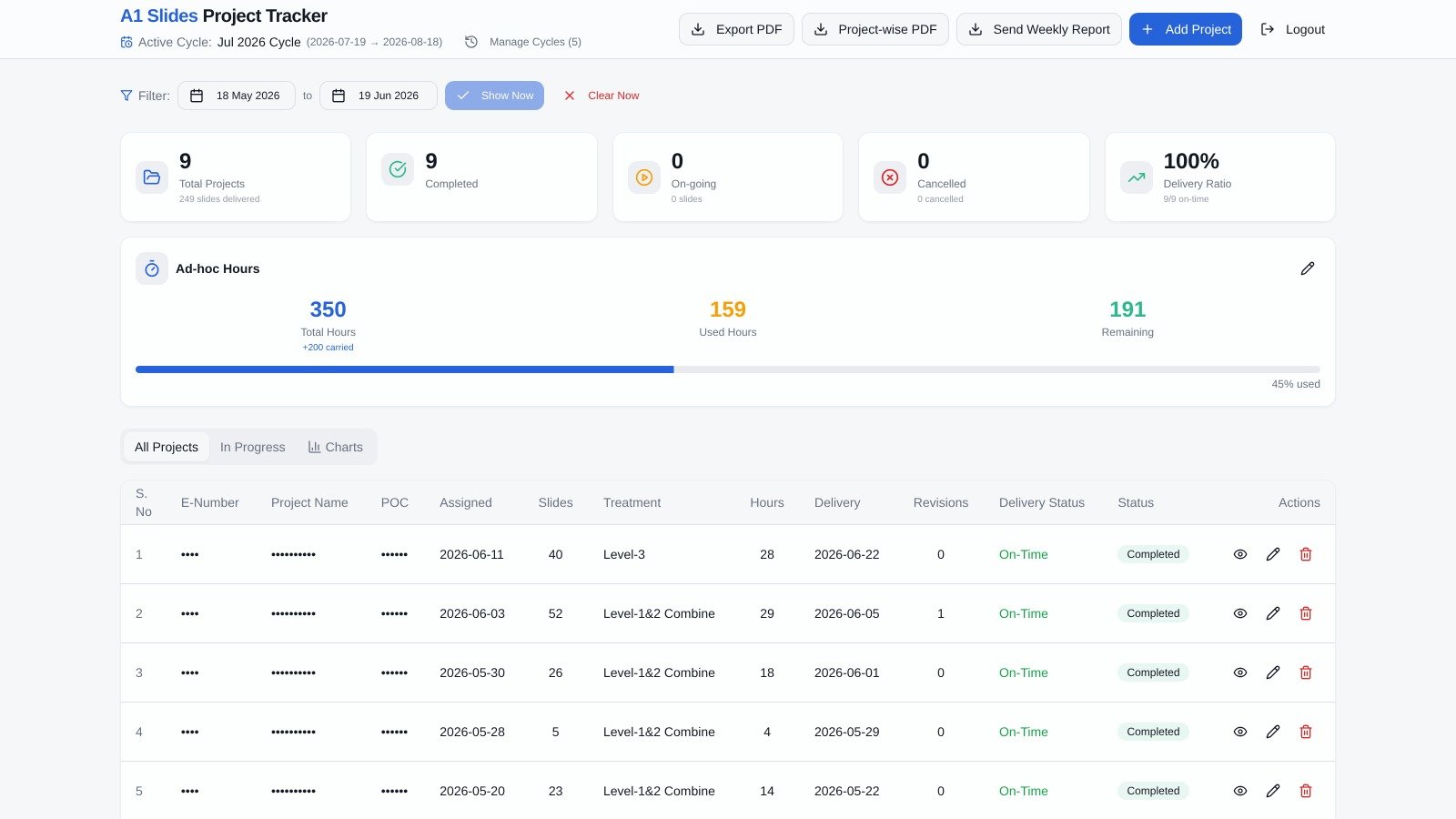
From there, the project is routed to the appropriate Principal and Presentation Operations Delivery (POD) team, where work begins according to the agreed delivery timeline.
The objective is not simply to accept files. It is to eliminate unnecessary coordination: no lengthy email chains, no scheduling around time zones, and no uncertainty over project status.
How it works: Upload the project, return to your priorities, and your completed presentation is delivered directly to your inbox within the committed timeline.
It is another step in making presentation execution as seamless as the strategic thinking behind it.