Healthcare presentation designs are not like other presentations. The audience arrives with a baseline of clinical or commercial knowledge. The data is dense. The stakes — a funding decision, a regulatory submission, a board endorsement — are real. And the margin for misunderstanding is narrow.
Expert Perspective
"In my experience working with pharma and clinical teams across the UK and UAE, the most effective healthcare presentations share three things: a clear narrative arc that moves from problem to evidence to implication; data visualisation that earns its place on the slide rather than decorating it; and a logical handoff between scientific content and the decision it is meant to support. What consistently goes wrong is the assumption that thoroughness equals effectiveness. A 60-slide clinical deck with every data point is not the same as a 20-slide deck that tells a coherent story. The best healthcare communicators know the difference between showing their work and making their case."
Vaidehi Shukla, Principal Life Sciences & Market Research, Editor for Newsletter The Dose (UAE)
The most common failure isn't the data. It's the structure. A clinical team with a genuinely differentiated therapy, presenting payer submissions to a payer committee, can lose the room entirely — not because the evidence is weak, but because the deck is organised for the people who created it, not for the people evaluating it.
This guide covers the structural, visual, and narrative principles that separate healthcare presentations that drive decisions from ones that generate questions.
PowerPoint presentations have become indispensable communication tools in the healthcare industry, especially for pharma and life sciences presentations. Whether you’re presenting clinical trial results, introducing new medical devices, training healthcare professionals, or pitching to investors, the effectiveness of your presentation can significantly impact your message’s reception and outcomes.
In today’s complex healthcare environment, the ability to communicate complex medical information clearly and engagingly is more crucial than ever, making mastery of PowerPoint an essential skill for healthcare professionals.
Understanding Your Foundation
Define Your Purpose and Audience
The foundation of any successful healthcare presentation design lies in its purpose and audience alignment.
Before opening Microsoft PowerPoint, take time to analyze who will be viewing your presentation and what you want them to take away from it. For instance, when presenting clinical trial results to fellow physicians, you’ll need to include detailed methodology and statistical analysis, whereas when presenting the same information to patients or investors, you’ll want to focus on outcomes and implications.
This initial analysis will guide every subsequent decision in your presentation development, from the level of technical language used to the types of visuals employed.
Healthcare Presentation Design Elements
Template Selection
The template you choose sets the tone for your entire presentation and can significantly impact how your message is received. For healthcare presentations, professionalism is paramount, but this doesn’t mean your slides need to be boring.
Modern healthcare presentations often benefit from a clean, minimalist design that incorporates subtle gradients and strategic use of white space. Consider how major healthcare organizations like Mayo Clinic or Cleveland Clinic structure their presentations – they typically use simple, elegant designs that put the focus on content while maintaining visual interest through careful use of color and imagery.
Color Theory in Healthcare Presentations
Color choices in healthcare presentations go beyond mere aesthetics; they play a crucial role in data comprehension and emotional response.
Blues and greens, commonly associated with healthcare, can create a sense of trust and reliability, while judicious use of warmer colors like red or orange can highlight critical information. However, it’s essential to consider the psychological impact of colors in healthcare contexts – for example, excessive use of red might create anxiety when presenting patient outcomes, while cool blues can help maintain a calm, professional atmosphere during complex medical discussions.
Content Development and Organization
Structuring Your Presentation
The structure of your healthcare presentation should follow a logical progression that builds understanding systematically.
Think of it as similar to a medical consultation:
you begin with the primary complaint (the problem or topic),
move through the examination (analysis and evidence), and
conclude with the treatment plan (solutions or recommendations).
This medical analogy can help create a familiar and effective flow for healthcare audiences. Each section should build upon the previous one, creating a coherent narrative that leads to your desired outcome.
Visual Elements and Data Presentation
Effective Use of Images
In healthcare presentations, the right visual can often communicate complex concepts more effectively than paragraphs of text. When selecting images, prioritize medical accuracy and professionalism over artistic appeal.
For instance, when presenting surgical techniques, use detailed anatomical illustrations rather than simplified clipart. Remember that every image should serve a purpose – whether it’s explaining a procedure, illustrating a concept, or providing evidence of outcomes. Consider creating a library of pre-approved, high-quality medical images that comply with both copyright and HIPAA regulations.
Data Visualization Best Practices
Healthcare presentations often involve complex data sets that need to be communicated clearly to diverse audiences. The key is to transform raw data into meaningful insights through appropriate data visualisation.
For example, when presenting patient outcomes over time, a line graph might be most appropriate, while comparing treatment efficacy across different patient groups might be better served by a bar chart. You can learn more about graph selecting tool for healthcare presentation from here
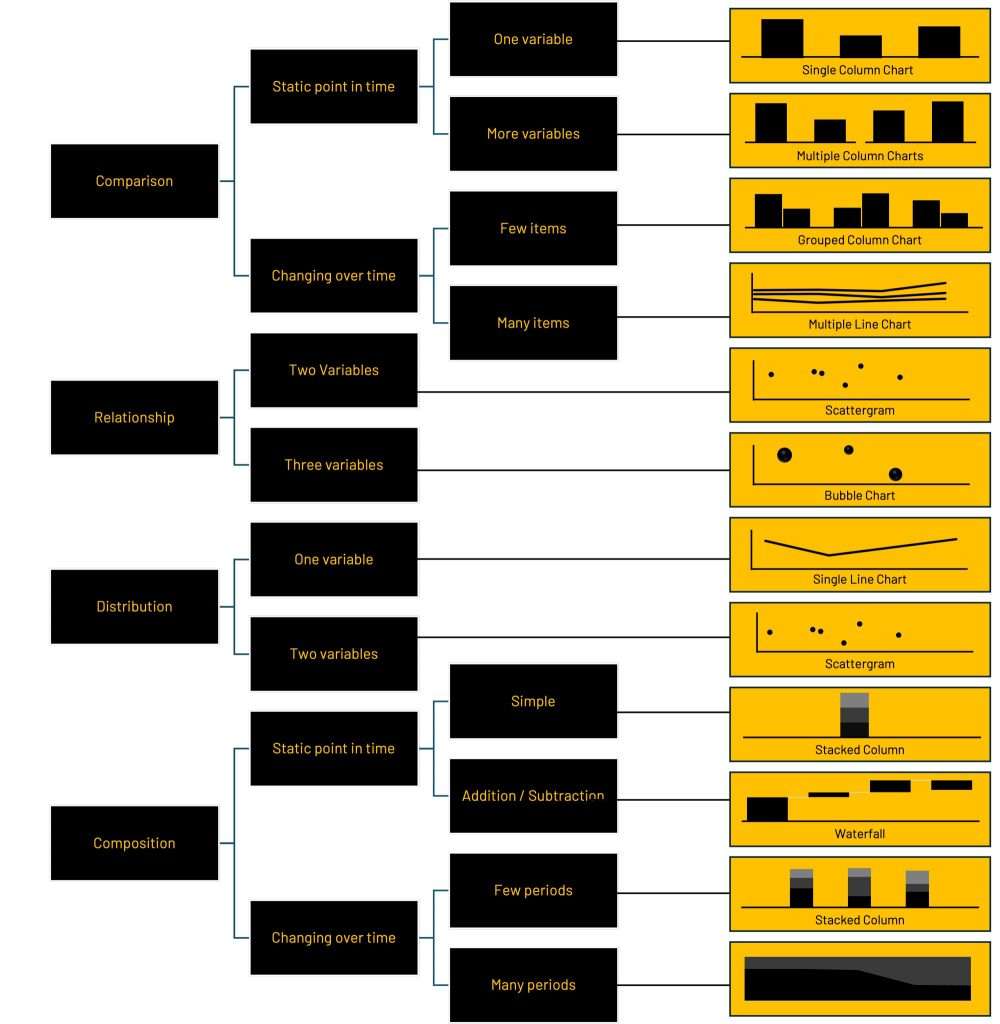
Remember to consider your audience’s data literacy level – what might be immediately clear to a statistician might need additional context for administrators or patients.
Technical Considerations
Text and Typography
Typography in healthcare presentations requires a delicate balance between readability and professionalism. Your font choices should prioritize clarity while maintaining a modern, authoritative appearance.
Consider using sans-serif fonts like Arial or Calibri for body text, as they remain legible even at smaller sizes and when projected. Headers can use slightly more stylized fonts, but should still prioritize readability over decoration.
Remember that your audience might be viewing your presentation from various distances and angles, so test your font sizes and contrast under different conditions.
Animations and Transitions
When used thoughtfully, animations and transitions can enhance understanding of complex medical concepts.
For example, when explaining a disease progression or surgical procedure, step-by-step animations can help audiences follow the sequence of events. However, every animation should serve a purpose – avoid decorative animations that might distract from your message.
Consider using simple fade or appear effects for revealing bullet points, and smooth transitions between slides to maintain professional polish.
Healthcare-Specific Considerations
Compliance and Regulations
Healthcare presentations must navigate a complex regulatory landscape. Whether you’re presenting clinical data, patient information, or marketing materials, ensure your content complies with relevant regulations like HIPAA, FDA guidelines, and institutional policies.
This includes proper citation of sources, appropriate disclaimers, and careful handling of patient information. Create a compliance checklist for your presentations to ensure nothing is overlooked.
Industry Best Practices
Healthcare presentation best practices continue to evolve with the industry. Stay current with how leading healthcare organizations present information, and adapt your approach accordingly.
This might include standardizing how you present statistical significance, incorporating evidence-based practice guidelines, or following specific formatting for clinical data presentation. Regular review of industry publications and continuing education can help keep your presentation style current and effective.
Healthcare Presentation Design Preparation and Delivery
Technical Preparation
Technical issues can derail even the most well-prepared presentation. Conduct thorough testing of all technical elements, including embedded videos, animations, and hyperlinks.
Have backup plans for common technical issues – for example, keep a PDF version of your presentation available in case of PowerPoint compatibility issues. If presenting virtually, test your presentation platform in advance and prepare for potential connectivity issues.
Rehearsal Strategies
Effective rehearsal is crucial for healthcare presentations, where precision and clarity are paramount. Practice not just the delivery of information, but also handling potential questions and technical challenges.
Record yourself presenting and analyze your delivery, paying attention to pacing, clarity, and engagement. Consider rehearsing with colleagues who can provide constructive feedback from different professional perspectives.
Post-Presentation Considerations
Distribution and Follow-up
The impact of your presentation extends beyond the actual delivery. Plan how you’ll distribute materials afterward, considering both digital and print formats.
Create supplementary materials that support your presentation’s key points, and establish a follow-up strategy to address questions or concerns that arise after the presentation.
This might include scheduling follow-up meetings, providing additional resources, or conducting surveys to gauge effectiveness.
Documentation and Archiving
Maintaining proper documentation of your presentations is crucial in healthcare settings. Develop a system for archiving presentations that includes version control, source documentation, and usage tracking. This not only helps with compliance but also creates a valuable resource for future presentations.
Consider creating a presentation template library that can be easily updated as new information or guidelines emerge.
By following these expanded guidelines and incorporating detailed considerations for each aspect of your presentation, you can create more effective and impactful healthcare presentations that serve their intended purpose while maintaining professional standards and regulatory compliance.
Life Sciences Presentation Resources
Clinical Data Visualization Playbook
Learn how to visualize HEOR and Phase III clinical trial data
Frequently Asked Questions
Healthcare presentation design is the process of structuring and visualising clinical, scientific, or medical information for specific audiences — HCPs, payers, patients, or executives. It differs from standard presentation design because every layout, data visualisation, and emphasis decision must account for scientific accuracy, regulatory compliance, and the communication needs of a specialist audience.
A good healthcare presentation leads with the insight the audience needs to act on, presents clinical data faithfully without extrapolation or selective emphasis, uses visual hierarchy to reduce cognitive load, and is structured so that a reviewer — whether a physician, payer, or regulator — can navigate it quickly without prior knowledge of the study design. Compliance with MLR or regulatory standards is built into the architecture from the first slide, not added at the review stage.
Pharma and medical presentations must meet scientific and regulatory standards that standard business presentations do not. Every data claim must trace to an approved reference. Visual emphasis — bold text, large callouts, oversized statistics — can constitute a promotional claim requiring MLR sign-off. Clinical data visuals such as Forest plots and Kaplan-Meier curves must be reproduced exactly as published. These constraints make pharma and medical presentation design a specialist discipline, not a design generalist task.
A1 Slides designs MSL and Medical Affairs decks, KOL meeting presentations, HEOR and payer engagement decks, biotech investor presentations, clinical data readout slides, congress posters, market access submissions for NICE and HTA bodies, disease state overview decks, and internal launch readiness materials for pharma and life sciences organisations.
Healthcare presentations require distinct design approaches for each audience. HCP-facing decks lead with clinical evidence and use peer-level scientific visual language. Payer and HTA submissions lead with cost-effectiveness logic and must be readable by a formulary committee under time pressure. Patient-facing materials use plain language and accessible design. Executive and investor decks translate clinical complexity into commercial narrative. A1 Slides engineers each deck type for its specific audience from the brief stage, not as a template adaptation.
MLR-compliant presentation design means building pharmaceutical or medical presentations so that every claim is traceable to an approved reference, visual hierarchy does not over-emphasise benefit information relative to risk, data visualisations are reproduced faithfully from source publications, and the annotation architecture — footnotes, superscript references, source lists — is embedded into the slide template from the start. MLR compliance built into the design eliminates the revision cycles that occur when compliance is treated as a final review step.
A1 Slides delivers healthcare and pharma presentations within 24 hours. Source materials — a draft deck, published clinical data, or a brief — sent at close of business are returned as a formatted, review-ready PowerPoint by 8:00 AM the following morning. For congress deadlines, NICE submissions, or investor meeting preparation, overnight delivery is our standard model.
For internal general communications, a generalist designer may suffice. For any presentation that will be reviewed by MLR, presented to a KOL or payer, submitted to an HTA body, or used in a congress or investor context, a specialist agency is necessary. Generalist designers do not understand claim boundaries, data visualisation integrity requirements, or the annotation standards that regulatory reviewers expect. Errors in these areas are not design mistakes — they are compliance failures.