What is the McKinsey Presentation Framework?
The McKinsey Presentation Framework is a system of five interlocking principles used by McKinsey & Company consultants to structure, design, and deliver executive presentations that drive decisions rather than communicate information. The five principles are: the Pyramid Principle (answer first), Action Titles (insight not topic), MECE data structure (Mutually Exclusive, Collectively Exhaustive), the Ghost Deck method (structure before design), and Signal-to-Noise discipline (remove everything that doesn't prove the point).
TL;DR — The five rules
- Pyramid Principle: lead with the answer, then prove it.
- Action Titles: write the insight, not the topic.
- MECE: structure evidence without gaps or overlap.
- Ghost Deck first: validate the logic before design.
- Signal-to-noise: remove everything that does not prove the point.
This is what exactly we do at A1 Slides using our Insight First Design, we partner with top-tier management consultancies to scale their visual output.
The framework is industry-agnostic in its logic but industry-specific in its application. A McKinsey Partner presenting a portfolio strategy to a pharma board applies the same Pyramid Principle as a BCG consultant presenting a market entry recommendation to a retail CEO - but the content standards, data visualisation requirements, and audience expectations are entirely different.
In regulated industries like pharmaceutical and life sciences, applying this framework carries an additional layer of complexity. When an MSL team builds a KOL meeting deck using McKinsey's action title structure, every claim on every slide must simultaneously serve as a persuasive narrative anchor and survive Medical, Legal, and Regulatory review. The Pyramid Principle tells you to lead with the conclusion - but in a pharma context, that conclusion must be referenced, balanced, and annotation-compliant before it can appear at the top of the slide.
This is why life sciences teams increasingly separate the narrative architecture work - applying the McKinsey framework to structure the argument - from the visual production work, where compliance and domain expertise determine what the final slide actually looks like. Our MSL slide deck design practice exists specifically at this intersection - Pyramid Principle structure, built MLR-ready from the first slide.
In this playbook, we break down the exact architectural rules used to design "McKinsey-style slides" and how you can apply them to your next high-stakes boardroom presentation.
While understanding the framework is the first step, executing it flawlessly at scale requires partnering with expert presentation consultants.
Expert Insight by Alina Aron
Consulting-style communication works when the storyline makes the decision feel financially and strategically inevitable. The structure has to make the investment logic, trade-offs, and recommendation visible before design polish begins.
Reviewed by Alina Aron, Principal, M&A and Fundraising Strategy, A1 Slides
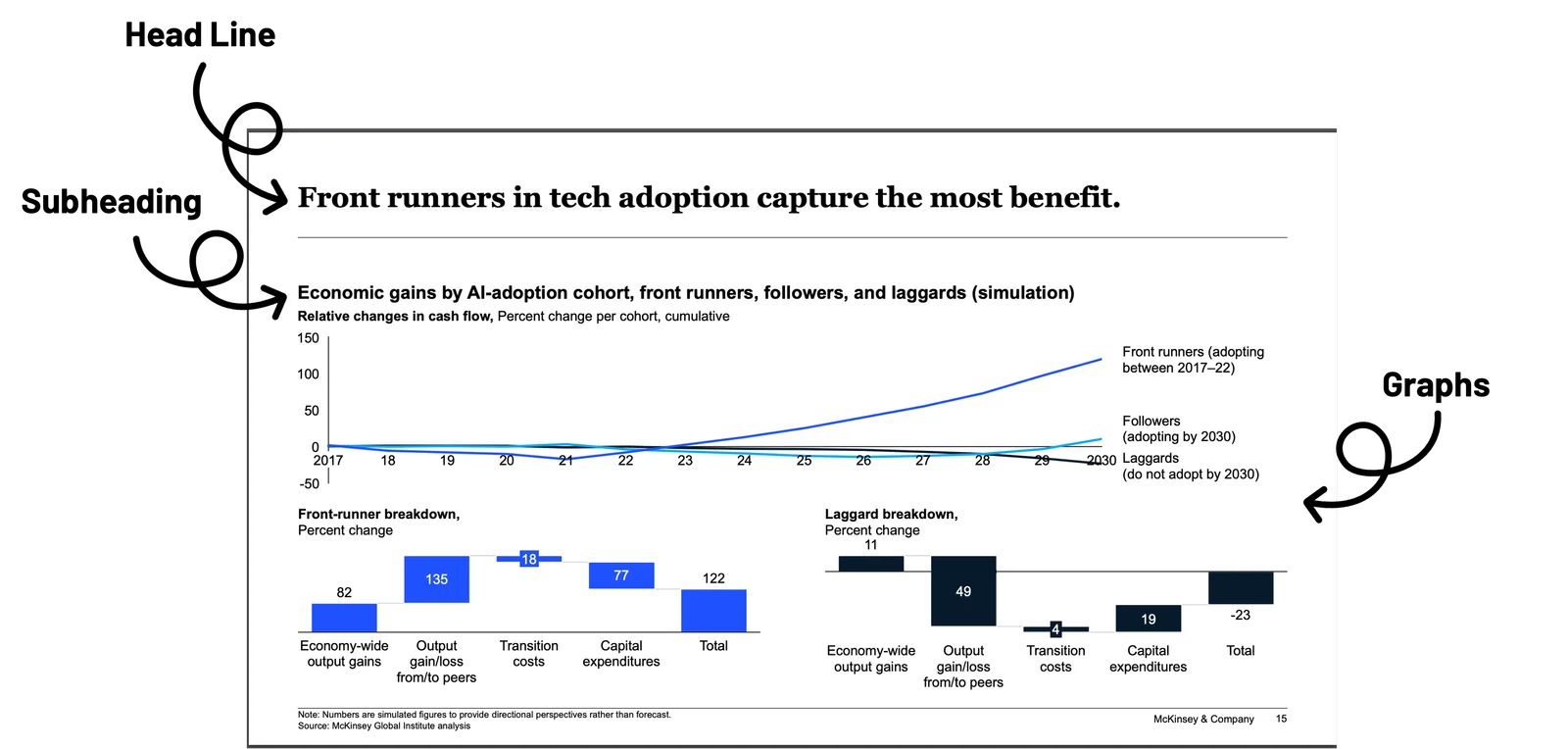
What Does a McKinsey Slide Deck Look Like?
A McKinsey slide deck is built backwards from how most teams build one. The deck opens with the recommendation, not the agenda — the first three slides carry the entire strategic answer, so a CEO who leaves after five minutes still knows what to do.
From there, every slide follows the same pattern: one action title stating the insight, one exhibit that proves it, nothing else competing for attention. There's no separate "findings" section and "recommendations" section — the recommendation is the spine the whole deck is built around, and each slide is a link in that chain.
A typical McKinsey-style deck runs 15-30 slides for a strategy engagement: an executive summary (2-3 slides), the core argument built slide-by-slide using the Pyramid Principle, and an appendix carrying the detailed data that supports but doesn't clutter the main narrative. What separates it from a standard corporate deck isn't the slide count — it's that every slide has already passed the read-through test before it reaches the audience.
Rule 1: The Pyramid Principle (Top Down Logic)
Barbara Minto first suggested the Pyramid Principle and later that became the norm for consultancies to present to their clients. This principle is very different to a traditional presentation using "bottom-up" logic where they show all their research, explain their methodology, and finally reveal the conclusion on slide 40.
McKinsey-style presentations use Barbara Minto’s Pyramid Principle which basically says, you must deliver the conclusion first, followed by the supporting arguments, and finally the granular data.
How to design for this:
The Executive Summary: Your first 3 slides must contain the entire strategic recommendation. If the CEO leaves the room after 5 minutes, they should still know exactly what to do.
The Vertical Logic: If a stakeholder reads only the title of a slide, and then looks at the chart below it, the chart must directly prove the title. No extra fluff.
Rule 2: Action Titles Over "Topic Titles"
The most common mistake in corporate presentations is the "Topic Title."
Bad (Topic Title): "Q3 Financial Performance" or "Market Analysis."
Good (Action Title): "Q3 Revenue dropped 14% due to supply chain bottlenecks in APAC, requiring immediate vendor diversification."
In a McKinsey-style deck, the slide title is the most important real estate on the page.
It must state the "So What?" The "Read-Through" Test: If you strip away all the charts and graphics and only read the slide titles from slide 1 to 25, it should read like a cohesive, persuasive essay. We call this the "Narrative Spine."
Executive Resource: Want to see these rules in action? Download our report The Executive Presentation Outlook (Requires Business Email)
Action Title Transformation Table — 10 Real Examples:
| Weak Topic Title | McKinsey Action Title |
|---|---|
| Q3 Financial Performance | Q3 Margins Dropped 14% Due to APAC Supply Chain Failures — Immediate Vendor Diversification Required |
| Market Analysis | Southeast Asian Biosimilar Market Will Grow 14% CAGR by 2028 — Three Competitors Already Positioned |
| Competitive Landscape | Our Window for First-Mover Position Closes in 18 Months as Three Rivals Enter the Payer Channel |
| Team and Resources | Current Headcount Cannot Support Q2 Launch Without External Capacity — Two Options Available |
| Customer Research | 67% of Enterprise Buyers Decide on Vendor in First 90 Seconds of a Pitch — Design Is the Deciding Factor |
| Revenue Overview | Revenue Growth Is Masking a Margin Compression Problem That Will Surface in Q2 Without Intervention |
| Strategic Options | Option B Delivers 3× the NPV of Option A at Half the Integration Risk — Recommendation Is Clear |
| Clinical Data | Phase III PFS Data Outperforms Standard of Care by 4.2 Months — Statistically Significant at p<0.001 |
| Operational Review | Manufacturing Bottleneck in Site 3 Is Costing £2.3M Per Quarter and Will Worsen Without Capex |
| Launch Readiness | Launch Is 6 Weeks Behind Schedule — Three Decisions Required by Friday to Recover the Timeline |
The read-through test - how to validate your action titles before production
The definitive quality check for action titles is what McKinsey consultants call the read-through test. Strip every chart, every data visualisation, every body text from the deck. Read only the slide titles in sequence, aloud, from slide 1 to the final slide.
If the sequence of titles tells a logical, complete, and persuasive story - if someone listening to the titles without seeing a single supporting element would understand the situation, the problem, and the recommendation - your horizontal logic is sound.
If the titles read as a list of topics, repeat information across slides, or fail to connect causally from one to the next, the deck's argument has structural gaps that no amount of design will fix.
This test costs nothing and takes three minutes. It is the most valuable quality check in the McKinsey communication process - and the one most commonly skipped under deadline pressure.
Why action titles matter differently in regulated industries
In standard corporate presentations, a weak action title is a communication failure - the audience misses the insight, the slide underperforms. In regulated pharma and medical affairs presentations, a weak action title can be a compliance failure.
When an action title over-claims - "Drug X Eliminates Treatment Resistance" instead of "Drug X Significantly Reduces Treatment Resistance in 67% of Trial Participants (p<0.001)" - the visual emphasis of that headline becomes a regulatory claim. The Medical, Legal, and Regulatory committee reviewing the deck does not evaluate it as a communication problem. They evaluate it as a promotional claim problem.
This is one of the most common failure modes in medical affairs presentation design - action titles written for persuasive impact rather than compliant accuracy. The McKinsey framework teaches you to write the insight. In life sciences, that insight must be the exact, referenced, approved finding - not a marketing distillation of it.
How to write action titles for different audience types
| Audience | Action Title Standard | Example |
|---|---|---|
| Board / C-Suite | Decision-forcing, outcome-led | Exiting APAC Frees £180M Capex for Core Market Re-Investment - Board Decision Required |
| Strategy / Consulting | Evidence-led, recommendation-clear | Competitor C's Phase III Failure Opens a 14-Month Market Entry Window - Three Options Modelled |
| Medical Affairs / KOL | Referenced, claim-bounded, MLR-compliant | Phase III PFS Improvement of 4.2 Months vs SOC (HR 0.61; 95% CI 0.48-0.77; p<0.001) - Primary Endpoint Met |
| Payer / NICE Committee | Cost-effectiveness-led, QALY-referenced | Model Projects £18,400 Cost Per QALY Gained - Below NICE Threshold at Base Case and in 87% of Sensitivity Analyses |
| Investor / Biotech BD | Value-inflection-led, milestone-anchored | Phase I Safety Data Supports Accelerated Phase II - 18-Month Milestone to Data Readout Requiring $12M Bridge |
The McKinsey framework gives you the architecture. The audience gives you the content standard. Getting both right simultaneously is the difference between a deck that passes review in one cycle and one that goes back three times.
Applying the McKinsey Framework to Data-Intensive Presentations
The five rules of the McKinsey framework were developed in a management consulting context where the primary data types are financial models, market analyses, and operational metrics. Applying them to data-intensive presentation contexts - clinical trial readouts, HEOR submissions, financial services regulatory reporting - requires additional discipline at the data visualisation layer.
Clinical and scientific data
The signal-to-noise rule is non-negotiable when presenting clinical trial results. A Forest plot showing 14 subgroup analyses simultaneously is not an MECE data visualisation - it is a data dump in graphical form. The McKinsey framework demands that you identify the one finding the slide must prove and engineer the visual around that finding.
For a Phase III oncology readout deck, this means: the primary endpoint slide shows the primary endpoint, clearly, with the confidence interval visible and the statistical significance annotated. The subgroup analyses are in the appendix - available for the oncologist in the room who wants them, absent from the main narrative that needs to land with an executive or payer audience.
This is the core challenge in clinical data visualisation - applying McKinsey's signal-to-noise discipline to datasets where scientific completeness and communication clarity pull in opposite directions. Getting both right requires understanding both the framework and the domain.
Financial services data
Revenue waterfall charts, portfolio performance attribution, and regulatory capital modelling outputs all benefit from MECE structuring - every component is distinct, together they sum to the whole. The McKinsey framework's insistence on single-insight slides prevents the common financial services failure mode of presenting three-year P&L trends, regional breakdowns, and forward guidance all on one slide because "the data is related."
It is related. It still needs to be three slides.
The annotation standard that changes with audience
Signal-to-noise discipline does not mean removing references and sources - it means putting them where they support the visual without competing with it. For a corporate board deck, source attribution sits in a small footnote. For an MLR-reviewed pharmaceutical deck or an HTA submission, the reference annotation is part of the compliance architecture and must be visible, complete, and linked to an approved source list. The McKinsey framework teaches you where the signal is. Your audience and regulatory context determines how much of the noise is actually required compliance infrastructure rather than genuine clutter.
Rule 3: The "Ghost Deck" (Structure Before Design)
This is where most companies miss. You should never open PowerPoint until your logic is flawless. Top consultants use a method called the "Ghost Deck" or "Dot-Dash Storyline."
Before any visual design begins, you map out the presentation on paper or a simple text document:
At A1 Slides, our Insight First Design™ methodology starts here. When enterprise clients send us a 100-page research dump, we don't start making it "pretty." We build a Ghost Deck to ensure the strategy is airtight before a single pixel is placed.
The Ghost Deck in practice - what it actually contains
A properly built Ghost Deck has four elements per slide and nothing else:
The action title
The complete insight sentence the slide exists to prove. Written in full, not abbreviated.
The lead sentence
One or two lines providing the context or framing that sets up the exhibit. Why does this data matter here, in this sequence?
The exhibit description
A plain-language description of the chart, table, or visual that will populate the slide. "Bar chart showing market share by player, 2022-2026, IQVIA data" not "market share chart."
The data status tag
Is the data confirmed, in progress, or not yet obtained? This is critical for production handoff. A production team cannot build the slide without knowing whether the data actually exists.
That is a complete Ghost Deck slide. No design. No formatting. Thirty seconds to create. All the information a visual engineering team needs to build the finished version overnight.
The McKinsey VGI model - and why it matters for every consulting firm
McKinsey's internal production advantage is rarely discussed publicly. Their Visual Graphics and Imaging (VGI) centre is a global overnight production function - consultants send their approved Ghost Decks with data at the close of business and receive fully formatted, McKinsey-standard presentations in their inbox the following morning.
This is why McKinsey consultants do not format their own slides. The Ghost Deck is their intellectual work. VGI handles the production. The consultant arrives at the morning client meeting with a finished deck - without having spent the night in PowerPoint.
Boutique and mid-size consulting firms - the Trinity Life Sciences, the ClearView Healthcare Partners, the Putnam Associates of the world - do not have internal VGI infrastructure. Their consultants either absorb the formatting burden themselves, or they partner with an external overnight production team that functions as their VGI equivalent.
A1 Slides is built to be that external VGI equivalent. Your team builds the Ghost Deck and validates the logic. We receive the approved structure and data at 6pm. A formatted, board-ready presentation is in your inbox by 8am.
For a deeper guide on building and deploying Ghost Decks in a consulting context, see our complete ghost deck presentation guide.
The SCR and SCQA Frameworks — McKinsey's Narrative Architecture
The Pyramid Principle governs the hierarchy of the argument. SCR and SCQA govern the narrative setup. They help a consulting deck move from a stable reality to a business problem and then to the answer the audience needs to approve.
| Element | What It Does | Example |
|---|---|---|
| Situation | Establishes undisputed current reality | Your retail division has grown revenue for five consecutive years |
| Complication | Introduces the problem or change that makes the current state unstable | Three digital-native competitors are now taking margin from the highest-value customer segment |
| Resolution | Presents the recommended solution | Repositioning to premium service tiers protects margin and slows churn |
| Element | Role |
|---|---|
| Situation | Current state — undisputed |
| Complication | Why the situation is no longer stable |
| Question | The explicit question the presentation answers |
| Answer | The answer — stated first, proved by body slides |
Use SCR when the recommendation is clear and the deck needs to create urgency. Use SCQA when the central question must be made explicit before the answer lands.
How to Build a McKinsey-Style Presentation — Step by Step
Define the governing thought: the one decision or recommendation the deck must make unavoidable.
Build the Ghost Deck in plain text before opening PowerPoint.
Apply SCR to frame the current situation, the complication, and the resolution.
Assign one insight per slide so each page has a clear job.
Apply MECE to the evidence structure so the proof is complete without overlap.
Remove everything that does not prove the point.
Send the approved structure to production for formatting, charting, and quality control.
Rule 4: MECE Data Visualization
Consulting slides are famous for being dense, but they are never cluttered. They follow the MECE principle: Mutually Exclusive, Collectively Exhaustive. When visualizing data on a slide, every element must have a distinct purpose (Mutually Exclusive), and together they must tell the whole story (Collectively Exhaustive).
Visual Rules for Consulting Decks:
Zero "Chart Junk": Remove 3D effects, background grids, and unnecessary legends.
The "Call-Out": If you use a bar chart showing 10 years of data, use a distinct accent color (like a bold blue or coral) to highlight the one specific year that proves your Action Title.
Tracker Bars: Use a tracker (a small highlighted navigation bar at the top or bottom of the slide) so the audience always knows where they are in the broader agenda.
The McKinsey Visual Grammar — Typography, Color, Grid, and Chart Selection
The Pyramid Principle, MECE, and Ghost Deck govern what the deck argues. The visual grammar governs what it looks like once the argument is right — and it's the part most teams skip straight past, which is why a logically sound deck can still read as amateur. Four rules cover most of it.
Typography: one typeface, three sizes, no exceptions
McKinsey-style decks use a single sans-serif typeface across the entire presentation — no mixing a serif title font with a sans-serif body font, no per-slide font swaps. Within that one typeface, there are three sizes and no more: the action title, the body/label text, and the footnote/source line. If a slide needs a fourth size to make a point, the point isn't structured clearly enough yet — that's a Ghost Deck problem, not a font problem.
Color: one brand palette, one accent color, nothing else
A McKinsey-grade slide uses your core brand colors for structure — headers, backgrounds, chart baselines — and reserves exactly one accent color, usually a bold blue or coral, for the single data point or line that proves the slide's action title. Every other color on the slide should be a neutral gray. The moment a chart has four different colors representing four different categories with no single one emphasized, the audience has to do the work of figuring out what matters. The accent color should do that work instead.
Grid: consistent margins, consistent alignment, real whitespace
Every slide in the deck uses the same margin and grid, so elements land in the same position slide to slide — the eye shouldn't have to re-orient itself each time a new slide appears. Whitespace is not empty space to be filled; it's what lets the one chart or one insight on the slide actually stand out. A slide that's 90% full is usually a slide carrying two insights that should have been split into two slides.
Chart selection: match the chart type to the comparison, not to what looks impressive
| What you're showing | Correct chart type | Common mistake |
|---|---|---|
| Change over time | Line chart | Using a bar chart, which implies discrete categories rather than a trend |
| Comparison across categories | Bar chart (horizontal or vertical) | Using a pie chart, which makes precise comparison difficult past 3-4 slices |
| Part-to-whole composition that changes | Waterfall chart | Using a stacked bar chart, which hides the sequence of changes |
| Distribution or range | Box plot or dot plot | Using a bar chart of averages, which hides the spread |
| Correlation between two variables | Scatter plot | Using a bar chart, which can't show the relationship at all |
The test is the same one that governs the rest of the framework: does this visual make the action title's claim obvious in under three seconds, or does the audience have to decode the chart type before they can even get to the data.
Rule 5: Maximizing "Signal-to-Noise" Ratio
Executive cognitive load is your biggest enemy. Our “The Executive Presentation Outlook 2025” highlights this in detail. If an executive has to spend 30 seconds figuring out how to read your chart, you have lost their attention.
A McKinsey-grade slide acts as an information filter. It removes the "noise" (data that is true, but irrelevant to the decision) and amplifies the "signal" (the exact insight driving the strategy).
How to Scale Consulting-Grade Presentations
Building McKinsey-style decks takes an immense amount of time. A standard 30-slide strategy deck takes a consultant 40 to 60 hours of structuring, formatting, and charting.
This is a massive misallocation of expensive talent. A Strategy Director should be analysing markets, not aligning text boxes at 2am. A Medical Affairs Director with a PhD in pharmacology should be designing KOL engagement strategy, not reformatting a Forest plot to fit a slide template. An M&A associate should be modelling deal economics, not rebuilding a valuation bridge chart because the previous version was built in Excel and does not match the deck's visual language.
The three-stage production model that top consulting firms use
The firms that execute the McKinsey framework at scale - consistently, across every client engagement, under overnight deadlines - have separated the work into three distinct stages with clear ownership of each.
Stage 1 - Narrative architecture (consultant-owned): Ghost Deck built, action titles validated, SCR structure confirmed, data availability checked. This is intellectual work that requires domain expertise and strategic judgment. No designer touches it.
Stage 2 - Production handoff (specialist-owned): The approved Ghost Deck and data files go to a visual engineering team at close of business. Chart types, exhibit specifications, brand standards, annotation requirements - all defined in the Ghost Deck. Production builds overnight.
Stage 3 - Review and refinement (consultant-owned): The consultant receives a formatted deck at 8am, reviews for strategic accuracy and visual integrity, and marks any revisions. Revisions are returned same morning.
This is the McKinsey VGI model - applied externally for any firm that does not have internal production infrastructure.
For life sciences strategy consultancies specifically, Stage 2 requires an additional layer: scientific accuracy review and MLR compliance awareness that a generalist production team cannot provide. Our life sciences consultancy case study shows what this model looks like in practice - 300+ slides per month, 20 slides in 8 hours, 80% of Principal consultant time returned to billable advisory work.
This is why top-tier consulting firms and Fortune 500 strategy teams partner with A1 Slides. We are trained in the Pyramid Principle and business logic. You hand us your approved Ghost Deck or data dump, and we deliver a high-fidelity, boardroom-ready presentation by 8am - at $16-$30 per slide, versus the £150-£300 per hour your consultants cost when they do it themselves.
The McKinsey Framework Across Industries - Where It Works and Where It Needs Adapting
The Pyramid Principle, action titles, MECE, Ghost Deck, and signal-to-noise rules are universal. What changes across industries is the content standard, the compliance layer, and the audience expectation for each element.
Management and strategy consulting: The framework works in its purest form. Pyramid Principle applied from the first slide. Action titles written for maximum decision-forcing impact. Ghost Deck reviewed by the Partner before production begins. Signal-to-noise discipline enforced by the consulting firm's own quality standards. The only variable is the deadline - which is almost always overnight.
Life sciences and pharma: The framework applies - but action titles must be claim-compliant, signal-to-noise must preserve the compliance annotation infrastructure, and the Ghost Deck must include MLR constraint notes alongside exhibit descriptions. A pharma brand planning deck built using McKinsey's framework and reviewed for MLR compliance before production is the gold standard. Most pharma teams achieve one or the other, not both. See how this works in practice in our pharmaceutical marketing presentations guide.
Biotech and investor communications: The Pyramid Principle is the most important rule for biotech investor decks - the governing thought (the investment thesis) must be on slide 1, the evidence hierarchy must flow top-down, and every slide must have a single action title that advances the investment argument. The Ghost Deck discipline prevents the most common biotech deck failure: building the narrative in the sequence the science was discovered rather than in the sequence a generalist investor needs to follow. Our biotech investor deck guide covers how to apply the McKinsey framework specifically to Seed, Series A, and Series B fundraising contexts.
M&A and private equity: The SCR framework is the primary tool - the management presentation's opening three slides follow Situation (this is the asset and its performance), Complication (this is why the current structure cannot maximise value), Resolution (this is what the acquisition unlocks). Every financial visual follows MECE structuring - waterfall charts sum to the whole, attribution analyses are exhaustive, no data point appears twice in different formats on the same slide.
Corporate and Fortune 500: The biggest challenge is signal-to-noise at scale - global teams produce decks that accumulate content through internal review cycles until every slide carries three insights, four data visualisations, and six bullet points. The McKinsey framework's single-insight-per-slide discipline is the corrective that most corporate communication functions need but rarely enforce systematically.
Frequently Asked Questions
The McKinsey presentation framework is a structured communication system used to build executive presentations that drive decisions. It combines the Pyramid Principle, action titles, MECE logic, Ghost Deck structure, SCR or SCQA narrative framing, and strict signal-to-noise discipline.
The Pyramid Principle means leading with the answer first, then supporting it with grouped arguments and evidence. In a McKinsey-style deck, the recommendation appears early and the rest of the presentation proves it.
An action title is a slide headline that states the insight, implication, or decision required. It replaces generic topic titles such as Market Overview with a complete message that tells the reader what the slide proves.
MECE means Mutually Exclusive, Collectively Exhaustive. In presentations, it ensures that the evidence is grouped without overlap and covers the full argument required to support the recommendation.
SCR stands for Situation, Complication, Resolution and is used to frame a business narrative quickly. SCQA adds Question between complication and answer, making it useful when the presentation must explicitly answer a strategic question.
The structure can be built in a few hours as a Ghost Deck, but a polished executive-ready deck often takes 24 to 72 hours depending on data complexity, review requirements, and production support. A1 Slides regularly turns approved Ghost Decks into board-ready presentations overnight.
McKinsey style presentation design refers to both the narrative framework — Pyramid Principle, MECE, action titles — and a consistent visual grammar: one typeface at three sizes, a single brand palette with one accent color for emphasis, consistent grid alignment across every slide, and chart types chosen to match the specific comparison being shown rather than for visual variety.
A McKinsey style report applies the same top-down Pyramid Principle used in McKinsey presentations to written documents — the executive summary leads with the recommendation, followed by supporting arguments grouped using MECE logic, with granular data and methodology moved to appendices rather than the main narrative.
A McKinsey slide deck opens with the recommendation in the first 2-3 slides, then proves it one insight per slide using action titles instead of topic titles, MECE-structured evidence, and a single accent color to highlight what matters on each chart. Supporting data sits in an appendix, not the main narrative.
McKinsey doesn't publish an official template — the firm's slides are proprietary, built by its internal VGI production team. What is public is the underlying structure: Pyramid Principle, action titles, MECE, and Ghost Deck-first production, which any team can apply to their own deck.