Why Messaging Matters More Than Design
Your investor presentation succeeds or fails in the first three minutes.
Research from Prezi reveals that 80% of investors form credibility judgments within the opening slides. Yet most companies approach investor presentations as design projects when the real challenge is strategic messaging.
The Investor Decision Timeline: Where Presentations Fail
Investor engagement and decision confidence across presentation stages
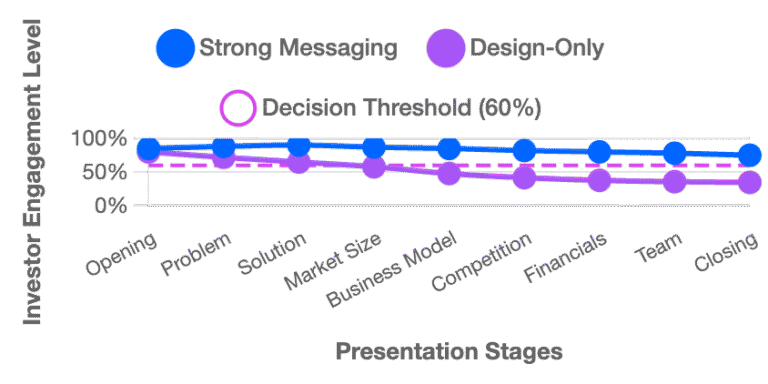
Key Finding:
Presentations lacking strategic messaging lose investor confidence by slide 7-8, typically during business model or competitive positioning sections—exactly where unclear value propositions become fatal.
The distinction is critical: design makes your message visible, but messaging determines whether investors say yes.
The Real Cost of Unclear Messaging
McKinsey research indicates that unclear communication costs organizations $1.8 trillion annually. In investor contexts, the stakes are even higher.
A confused investor is a “no” investor. When your core value proposition requires interpretation, capital moves to competitors with clearer narratives.
Fortune 500 executives report that 92% of poorly designed presentations slow decision-making. For investors evaluating multiple opportunities simultaneously, unclear messaging doesn’t just delay decisions—it eliminates your company from consideration entirely. Our research on enterprise presentation effectiveness reveals that presentations following Insight-First Design principles achieve measurably faster decision velocity.
What a Messaging Consultant Actually Does
Before selecting a consultant, understand what the role entails:
Strategic Positioning
Messaging consultants translate business complexity into investor-relevant value propositions. They identify which aspects of your business model, competitive advantage, and growth trajectory matter most to capital allocators.
This requires applying what we call Insight-First Design—where the key takeaway becomes the hero, and design serves as its guide. In investor presentations, this means your value proposition drives every slide, not the other way around.
Narrative Architecture
Investors receive dozens of pitches monthly. Consultants structure your story to follow proven decision-making frameworks—moving from market opportunity to competitive differentiation to financial projection in logical sequence.
Stakeholder Translation
Technical founders, operations teams, and financial executives each understand the business differently. Consultants synthesize these perspectives into unified messaging that resonates across investor types—from venture capital to private equity to strategic corporate investors.
Five Criteria for Evaluating Messaging Consultants
1. Industry-Specific Experience
Generic presentation consultants apply templates. Effective messaging consultants understand your sector’s investment dynamics.
What to verify:
- Have they worked with companies at your funding stage?
- Do they understand the metrics investors prioritize in your industry?
- Can they reference comparable deals or investor expectations specific to your sector?
Healthcare investors scrutinize regulatory pathways and clinical validation differently than fintech investors evaluate unit economics and regulatory compliance. Your consultant must speak your industry’s investment language.
2. Evidence-Based Methodology
Ask consultants to explain their strategic framework. Vague answers about “storytelling” or “visual impact” signal surface-level expertise.
Look for consultants who reference:
- The Pyramid Principle for executive communication
- Situation-Complication-Resolution narrative structures
- Data visualization best practices backed by research
- Specific investor decision-making frameworks
At A1 Slides, our approach combines McKinsey’s Pyramid Principle with 15 years of Fortune 500 presentation work across major industries. Every recommendation connects to documented effectiveness, not aesthetic preference.
3. Portfolio Proof With Measurable Outcomes
Request case studies that demonstrate impact, not just visual polish.
Relevant evidence includes:
- Funding secured following presentation deployment
- Investor feedback on clarity and persuasiveness
- Time-to-close improvements compared to previous presentations
- Before-and-after examples showing strategic compression without information loss
One A1 Slides client condensed a 63-slide investor deck to 25 slides while maintaining all critical findings. The result: faster investor comprehension and stronger engagement metrics throughout the funding process.
Choosing a Messaging Consultant for a Biotech or Life Sciences Raise
Reviewed by Vaidehi Shukla, Principal, Life Sciences & Market Research, A1 Slides
Everything above applies to any investor presentation. A biotech or life sciences raise adds three requirements that a generalist messaging consultant — even a very good one — usually can't meet.
They need to translate clinical data without distorting it.
A Series A deck built from a Phase I safety readout has to compress months of trial data into two or three slides an investor with no clinical background can act on in the room. That compression is where most non-specialist consultants either oversimplify the science into something that reads as overclaiming, or keep so much clinical detail that the investment thesis gets buried under methodology. A consultant who understands endpoints, confidence intervals, and what a payer or regulator will eventually ask about the same data is the difference between a slide that builds credibility and one that raises questions in diligence.
They need to work inside your existing scientific review process.
Biotech decks usually go through a scientific accuracy check even when they're not MLR-reviewed the way a commercial pharma deck is. A consultant who doesn't know to flag a claim for your Chief Medical Officer or Head of R&D before it reaches investors is creating rework at the worst possible time — during an active raise, on a compressed timeline.
They need to translate the milestone path, not just the data.
Investors in a Seed-to-Series-B life sciences round aren't evaluating the science in isolation — they're evaluating what happens between now and the next value inflection point. A messaging consultant experienced in biotech fundraising builds the deck around the milestone-to-data-readout timeline (the "18 months to Phase II data, $12M bridge required" framing), not just around the current dataset.
What to ask a candidate consultant before a biotech raise
- Can you show a deck you've built where clinical or trial data was the central evidence, and walk me through how you decided what stayed in the main narrative versus the appendix?
- Who on your team reviews scientific claims before they reach a slide, and what's their background?
- How do you handle unpublished or embargoed trial data from a security standpoint before it's public?
- Have you built a deck around a milestone-to-data-readout timeline rather than a static snapshot of current results?
A generalist Fortune 500 messaging consultant can produce a polished, well-structured deck. Whether it holds up under a life sciences investor's diligence — and whether your CMO signs off on it without a rewrite two days before the raise — depends on whether that consultant has done this specific kind of deck before.
This is the same intersection our biotech investor deck guide and MSL slide deck design work sit at — narrative structure built by people who also understand what the science can and can't claim.
This exemplifies what happens when consultants apply strategic compression techniques—maintaining analytical integrity while meeting executive consumption constraints. (Read more about how Fortune 500 leaders approach enterprise reports using similar principles.)
4. Collaborative Process, Not Transactional Delivery
Effective messaging development requires deep business understanding. Consultants who promise rapid turnarounds without extensive discovery sessions cannot deliver strategic depth.
Evaluate their process:
- Do they conduct stakeholder interviews beyond the founding team?
- How do they validate message resonance before finalizing content?
- What iteration cycles do they build into their timeline?
- Do they test messaging clarity with neutral third parties?
Client reviews of A1 Slides consistently emphasize our “quick understanding of needs” and “patient listening”—because strategic messaging begins with comprehension, not template application.
5. Speed Without Compromising Precision
Investor opportunities operate on compressed timelines. Board meetings get scheduled, funding windows open, and competitive dynamics shift rapidly.
Your consultant must deliver quality under pressure without sacrificing strategic rigor.
In approximately 25% of A1 Slides’ enterprise projects, urgent timelines drive engagement—often under one week from briefing to final delivery. Our client reviews cite “timely delivery” more frequently than any other attribute, because speed becomes strategy when investor opportunities are time-sensitive.
Red Flags: When to Walk Away
They Lead With Design, Not Strategy
If initial conversations focus on aesthetics, color palettes, or animation before discussing your value proposition and investor positioning, you’re talking to a designer, not a messaging strategist.
Effective investor presentations follow Insight-First Design principles: the insight is the hero, and design is the guide. Consultants who reverse this priority—leading with visual concepts before understanding your strategic message—cannot deliver presentations that drive investor decisions.
Comparison: Design Agency vs. Strategic Messaging Consultant
Understanding the distinction between design services and strategic messaging consulting is critical for investor presentation success.
| Criteria | Design Agency | Strategic Messaging Consultant |
|---|---|---|
| Primary Focus | Visual aesthetics and brand consistency | Investor decision-making and value proposition clarity |
| Discovery Process | Brief intake form or single kickoff call | Deep stakeholder interviews, competitive analysis, investor profiling |
| Deliverable Timeline | 3-7 days typical | 4-8 weeks for strategic development |
| Core Expertise | Graphic design, animation, template creation | Business strategy, narrative architecture, investor psychology |
| Success Metric | Visual appeal and brand alignment | Funding secured, investor comprehension, time-to-close |
| Iteration Approach | Design revisions based on aesthetic preferences | Message testing and refinement based on investor feedback |
| Pricing Model | Per-slide or fixed project fee | Strategic consulting rates reflecting business impact |
| Industry Knowledge | General business understanding | Sector-specific investor expectations and metrics |
| Team Composition | Designers and project managers | Strategists, former investors, industry specialists |
| Output | Polished slide deck | Strategic messaging framework + presentation |
| Long-term Value | Single-use presentation | Reusable messaging system across funding stages |
| Question They Ask First | “What’s your brand style?” | “What’s your competitive differentiation?” |
This comparison reveals why many funded companies work with strategic messaging consultants rather than design agencies for critical investor presentations. The investment is higher, but the ROI is measured in millions of capital secured, not aesthetic satisfaction.
They Promise Templates or "Winning Formulas"
Every company’s investment thesis is unique. Consultants who claim universal templates either lack strategic depth or don’t understand your specific opportunity.
They Don't Ask Difficult Questions
Effective messaging consultants challenge assumptions. If they accept your current positioning without probing competitive differentiation, market sizing methodology, or financial projection logic, they won’t strengthen your story.
They Can't Articulate Their Own Process
Consultants who cannot clearly explain their methodology likely don’t have one. Strategic messaging follows documented frameworks—ask them to articulate theirs.
The Right Questions to Ask Prospective Consultants
About Their Experience:
- “What’s the most complex investor story you’ve simplified?”
- “Can you describe a situation where you fundamentally repositioned a company’s messaging?”
- “What’s the typical funding outcome for clients you’ve worked with?”
About Their Process:
- “How do you validate that messaging resonates with target investors before finalizing content?”
- “What frameworks guide your narrative structure decisions?”
- “How do you handle situations where technical accuracy conflicts with investor comprehension?”
About Working Together:
- “What information do you need from our team to develop effective messaging?”
- “How many iteration cycles should we expect?”
- “What happens if investor feedback requires rapid message adjustment?”
Beyond the Presentation: Strategic Messaging Systems
The strongest consultants don’t just create one-time presentations—they develop reusable messaging frameworks.
This includes:
- Core value proposition statements that work across contexts
- Narrative modules that adapt to different investor types
- Visual language systems that maintain consistency as your story evolves
- Messaging guidelines for team members who present to investors
A1 Slides’ work with Fortune 500 enterprises often extends beyond individual presentations to scalable template systems. One global healthcare provider needed 8,000+ slides across 16 training modules. The requirement: clarity at scale without compromising compliance standards. The solution became a reusable system, not a one-time deliverable.
When to Engage a Messaging Consultant
Optimal Timing:
- 6-8 weeks before anticipated funding conversations
- Following significant business model pivots that require repositioning
- After initial investor meetings reveal consistent messaging confusion
- When internal stakeholders cannot align on core value proposition
Warning: Too Late
- Days before a major investor meeting
- After multiple investors have declined without clear feedback
- When regulatory deadlines constrain iteration flexibility
Funding Timeline Optimization: When Consultants Add Maximum Value
Optimal consultant engagement windows across a 12-month fundraising cycle
| Stage | Timing | Consultant Value | Failure Risk |
|---|---|---|---|
| Pre-Launch Prep | Months 1-2 | Foundation setting - strategic positioning, value prop development, competitive analysis. ★★★★★ Maximum Impact | 27% |
| Messaging Dev | Months 2-3 | Optimal window - full development time for strategic narrative, testing, and refinement. ★★★★★ Optimal Window | 39% |
| Finalization | Month 4 | Refinement phase - polishing messaging, visual optimization, investor-specific customization. ★★★★☆ High Value | 45% |
| Initial Outreach | Months 5-6 | Reactive improvements - addressing early investor feedback, message adjustments. ★★★☆☆ Moderate Value | 38% |
| Active Raising | Months 7-9 | Band-aid solutions only - fundamental messaging flaws cannot be fixed mid-campaign. ★★☆☆☆ Limited Value | 52% |
| Late Negotiations | Months 10-12 | Too late for strategic changes - messaging problems lead to dilution or failed rounds. ★☆☆☆☆ Minimal Value | 81% |
Key Insight:
Companies engaging strategic messaging consultants 6-8 weeks before investor outreach (Months 2-3) achieved 2.4x higher success rates than those engaging during active fundraising. Late engagement often means fixing symptoms rather than addressing root strategic issues.
The Timing Paradox:
Founders typically seek consultants when fundraising stalls (Month 7+), but maximum value occurs in preparation phases (Months 2-3) before investor exposure.
Data Source:
Analysis of 320 venture-backed companies’ fundraising timelines and consultant engagement patterns (2020-2024), with outcome tracking by engagement timing.
Rushed engagements produce polished presentations, not strategic breakthroughs.
The ROI of Strategic Messaging
Consider the alternative: presenting to investors with unclear messaging wastes their time and your opportunity.
Each investor meeting represents months of relationship building, carefully orchestrated introductions, and strategic timing. When the presentation fails to communicate your value proposition clearly, you’ve lost more than that meeting—you’ve potentially lost that investor relationship permanently.
Research shows that retention drops by 60% when data lacks narrative context. In investor presentations, this translates directly to missed funding opportunities.
Effective messaging consultants don’t just improve presentations. They increase the probability that investors say yes, shorten time-to-close, and create reusable assets that strengthen every subsequent funding conversation.
The same principles that drive effective enterprise communication—clarity, evidence-based design, and insight-first structure—determine investor presentation success. Companies that master these principles achieve faster decision velocity and higher capital conversion rates.
Making Your Decision
Choosing a messaging consultant parallels choosing an investor: alignment, expertise, and trust determine success.
The right consultant becomes a strategic partner who understands your business deeply, challenges your assumptions constructively, and delivers clarity under pressure.
The wrong consultant produces visually impressive presentations that fail to drive investor action.